Arthwaite
Welcome to Arthwaite, a fictional city in West Yorkshire. Like a modern-day Brigadoon, it comes into existence only when you enter one of my books. Its neighbours, Leeds and Bradford, sit shoulder to shoulder with an often hazy delineation between the two. Somehow, Arthwaite nestles between them. Characters may cross freely into actual places. So why go to the trouble of inventing somewhere?
In an early draft of The Price We Pay, I had a gruesome murder scene taking place in the car park of a well-known restaurant. On reflection, I could see how the owners might have a problem with double murders on the premises. It would definitely put you off your fillet steak. Now, all of that kind of action occurs in a completely made-up environment. Any similarity to real establishments is completely coincidental.
Several people have theories regarding disguised real-life locations. I can honestly say they’ve all been wrong. (Not that I would admit it if they were right!)
As you would expect, for two cities so close together, Leeds and Bradford share many characteristics, whether it’s geography, architecture or history. Their populations, however, are fiercely loyal, perhaps best illustrated by the intense but friendly rivalry between the Bradford Bulls and Leeds Rhinos. Personally, I’ve spent all but one year of my life living in the area. I was born in Bradford and call it home now, but I’ve also lived many happy years in Leeds. I have divided sporting loyalties — Bradford Bulls and Leeds United is a controversial combination in these parts. If you’ve read The Fifth Tweet, you may guess how I came by these loyalties.
It’s inevitable that in adding a third city into this mix, there are many similarities. It would be slightly odd if Arthwaite resembled Rome or New York, rather than its actual neighbours. Having said that, Arthwaite has its own Colosseum and a vast park in the inner city. The enormous concert hall was central to The Price We Pay, and Waller Park features heavily in the upcoming Book 2 – Fair Play.
I wanted the Arthwaite Police to be independent of the real-life West Yorkshire force for a couple of reasons. It meant I had much more artistic licence to portray corruption and general skulduggery, upsetting no one! It would also be easy to lose Carrie and her team in a much larger force. I wanted the force to be small enough that nobody questioned the number of juicy cases that came Carrie’s way. It also allowed me to house the lot in a hastily converted former hotel when their previous HQ fell down. I loved the idea of a city knowing its place and making do, rather than having a shiny modern building to play in.
Of course, Frankie and the rest of the cast of The Fifth Series walk the same streets even though they view them more light-heartedly. They have their own police officers watching over them, but Cagney and Casey are adept at avoiding contact with Carrie’s Major Crimes Unit. High-speed ice-cream van chases are more their style.
Repeat after me: I will not get sidetracked by getting Carrie involved with Frankie’s adventures. Then again, anything can happen in Arthwaite…
The Story of Arthwaite
The deleted prologue from Fair Play
Every city has its origin story. Arthwaite is no different.
When I began writing Fair Play, the second DI Carrie Tyler novel, I wanted readers to understand the city’s bones — the history that shaped its streets, its buildings, and the particular brand of corruption that runs through both books. So I wrote a prologue.
My editor was right to cut it. A crime thriller needs to open with a bang, not a history lesson, however much I enjoyed writing it. The book is better for its absence.
But the prologue itself didn’t deserve to disappear entirely. It tells the story of how Arthwaite came to be — the industrialists who built it, the workers who bled for it, and the uncomfortable truth that some things never really change.
Consider this an exclusive for anyone curious enough to look beyond the books.
Fair Play - The deleted prologue
Arthwaite in the middle of the nineteenth century was awash with money. A small number of men, and it was always men, quickly learnt how to amass sizeable fortunes. A promise of regular work and a roof over their heads attracted workers from the rest of the Yorkshire countryside. Those green fields were also home to vast numbers of sheep, a vital resource for the countless mills and factories that the men commanded. The mills needed machinery, so factories were built, turning local iron ore to steel. The foundries demanded coal, a plentiful black gold deep beneath the green countryside.
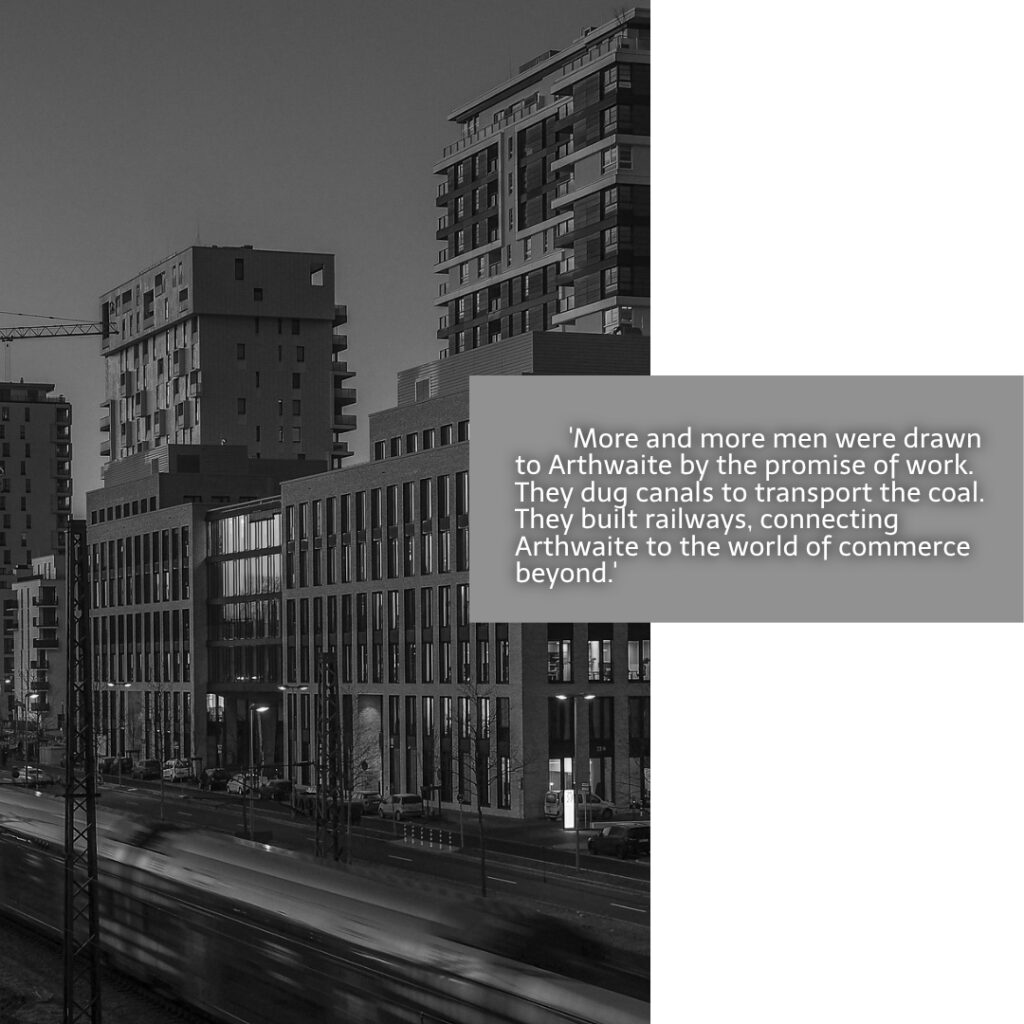
More and more men were drawn to Arthwaite by the promise of work. They dug canals to transport the coal. They built railways, connecting Arthwaite to the world of commerce beyond. The surrounding hills were no barrier. They simply tunnelled through them or went over them. Engineering feats the world could only marvel at. The longest railway tunnel. The highest aqueduct. Even the most complex system of locks. They gave their blood, sweat, and tears, and sometimes their lives, to feed the factories. Thirty-one men perished excavating the Holdsworth tunnel alone. They even gave their children to work in the mills. Always a ready flock of labour flooding the growing town, welcomed by that small group of all-powerful early industrialists. They watched as the green and pleasant land became scarred by spoil heaps and stone quarries. The blue skies got darker as a black smog gradually enveloped the town, but the men grew richer.
In celebration of their riches, they built beautiful homes for themselves on vast estates. Without today’s outlets to display their wealth, it was the buildings which were lavished with every adornment imaginable. Then a small number turned their attention to benevolence.
A genuine attempt to improve the lives of their workers or a ploy to stop them drinking themselves incapable before the next shift?
Whatever drove them, a legacy of institutes, libraries, schools, and theatres, all housed in ornate, awe-inspiring, buildings, was born. Each bore the name of the family which had bequeathed a tiny portion of its wealth. The buildings and the names survived, but the wealth had ebbed away over the century and a half since Arthwaite was granted city status. Even half the railway was closed, leaving behind ghostly tunnels, bridges going nowhere, and canals stagnating.
Now, a new generation of wealth makers ruled the city. Once wool, steel, and coal had brought unimaginable riches. Now it was heroin, cocaine, and an array of exotic chemicals. Again, a few families controlled the wealth. Where once the founders built industrial palaces, today’s power came from colonising existing buildings like cockroaches. The bodies still piled up, but not from digging tunnels.
And still the men made vast fortunes.
It was always men.